"This music of yours. A manifestation of the highest energy—not at all abstract, but without an object, energy in a void, in pure ether—where else in the universe does such a thing appear? But here you have it, such music is energy itself, yet not as idea, rather in its actuality. I call your attention to the fact that is almost the definition of God. Imitatio Dei—I am surprised it is not forbidden."
– Thomas Mann, Doctor Faustus, Ch. 9, 1947 (trans. 1948)
– Thomas Mann, Doctor Faustus, Ch. 9, 1947 (trans. 1948)
1. The Eyes of a Child
Despite their resounding declarations to the contrary, The Moody Blues are far more than just singers in a rock and roll band to me. Consider a typical middle-class, nine-year-old, Central Illinoisan kid circa 1980, alone in his bedroom—and now add The Moody Blues' melodic and sublime "Watching and Waiting" as his favorite song of all time. That was me, for a while anyway. I guess something meaningful happened each time I listened to that song. It didn't matter to me that the hand-held tape recorder playing the song under the covers at night in my bedroom was very basic and monaural—I don't think I knew yet what mono and stereo were—and nor did it matter to me that I was a bit lonely.[1] I just knew the wallowing I did to the music as I repeatedly rewound and played the tape was therapeutic. The lead singer's voice, the somber string section—it all took me someplace else entirely, a place where the music understood me and I understood it. The lyrics! (If you don't know, you should look them up.) What exquisite despair! What beautiful gloom.
Back then I strove to be a Christian, more due to the influence of my mother—who took me to Catholic church and grade school—than to any power of will of my own. In fact, at the time I believed in a God who actively worked against me. It only made sense that since there was so much wrong with the world as I saw it, and since God presumably would possess the power to change those things, He must therefore be nonchalant or cruel. I suppose you could argue I used my beliefs to solve the age-old problem in the philosophy of religion: the presence of evil in the world while an allegedly loving God does nothing to stop it. My solution made the most sense to me: He isn't stopping the evil, after all, because He is causing it!
Not in abundance, but my family did possess food, a house, audio equipment, dogs, and some comforts. Nevertheless, like most children perhaps, my thinking mostly consisted of self-centered thoughts with some wild abandon. Aren't we convinced that we are the center of the universe when we are young because we are, in a way? When we are young children, we inhabit a space in which our guardians focus on our safety; or at least ideally, we should exist in such a place. It's no wonder that as we begin to acquire a sense of self-within-society between the ages of five and ten, we also carry forward the vestiges of patterns of thought from early childhood. Time and sometimes difficult life lessons become our best teachers, really—in order to learn that we in fact do not occupy the locus of everything.[2]
To be clear, I didn't think "Watching and Waiting" existed purely for me in some deluded fashion, because really, I instead took great comfort in its being something entirely other than me to which I could connect, a larger and more tangible realm that I could truly feel in my body as a sensation. That differed in every way imaginable from my sensory experiences involving the God I had come to believe in; rather, the song ultimately provoked a religious passion in me.[3] Forty-five years have passed since those days under the covers with a cassette tape player, yet I still recall that slow moment of social awakening: I saw deeply that the singer sang for himself as well as on behalf of others and me, and so a profound compassion [4] began to arise within me. It was essentially everything musically for which I'd been watching and waiting. Sympathy and understanding hit me immediately, every time I heard it.
In the best language I can muster about it, I'd say the song was the most beautifully sad, tragically wonderful four minutes I'd ever experienced; each listen unfolded as an escape for yours truly into a strangely familiar though distant place with a morose but very lush sound, coupled with the longing for an imagined utopia or at the very least some better world. Informed by music theory now, I can see how the plodding Fmaj7 to Em chord change in the verses and the melancholy Mellotron string section throughout have informed my understanding of melodic expression and social emotion in music, from my love for the sounds of Cocteau Twins in the early 1990s to Radiohead in the 2000s. And yet, the lyrics of "Watching and Waiting" that I identified with when I was nine were rather short term as it turned out. By the time my younger brother and I formed our childhood bedroom band, The Meatpies, just three years thereafter, I felt I'd gained a close companion in my sibling. Eventually I made friends with many people. More recently I married, and my wife and I now have a son. I'm no longer lost in the dark looking for someone to understand me, having found some who do. It wasn't very long after all as it turned out.
2. Who Is the Artist?
I sometimes wonder about the sincerity of rock stars when they suddenly express an interest in a religion. For whatever reasons, I don't doubt members of U2 in regard to their professed affinity for Christianity, maybe because I can actually imagine them as sometime churchgoers. But, I wonder whether Jim Morrison, for instance, didn't investigate Native American spirituality mostly for the access it brought him to peyote. Likewise, it occurs to me that the members of The Moody Blues might be among those rockers who merely dabbled in Indian mysticism. It's impressive then, however, that for the recording of their song "Om" guitarist Justin Hayward played the sitar himself and drummer Graeme Edge played the tabla. Speaking from calloused firsthand experience, sitar can be quite a challenging instrument to play, requiring much patience and control. The Moodies were not, from what I understand, your average sex, drugs, and rock 'n' roll musicians either—not the way most of The Beatles were short-term students of transcendental meditation with the Maharishi Mahesh Yogi in 1968.[5]
I guess I find it sort of suspect when a musician becomes religious in a way foreign to their society of origin simply because the lifestyle associated with such a touring performer can be full of flirting with new ideas. The travel with exposure to a variety of cultures, the psychological pressures of being on stage, the ready availability of maladaptive coping mechanisms like drugs—it all makes for a dynamic and chaotic situation fertile for the planting of systems of thought which (if viewed purely on a superficial level) can appear to support one's other, more reckless, activities. That is, when the drugs become boring, you attempt to "achieve enlightenment" via meditation (maybe while high), or when normal promiscuity leaves you feeling empty, you explore tantric sex with a groupie. These options in life has presented distinct and very modern difficulties for artists who reach a high level of success at a young age and/or suddenly: Janis Joplin, Jimi Hendrix, Kurt Cobain, Syd Barrett, Keith Moon, Michael Jackson, and so on. Perhaps we can read a lot into the fact that The Moody Blues seemingly never succumbed to any of the excesses of the party life, and so I'm left to wonder if they weren't in fact for the most part sincere in their interest in and application of Eastern mysticism.
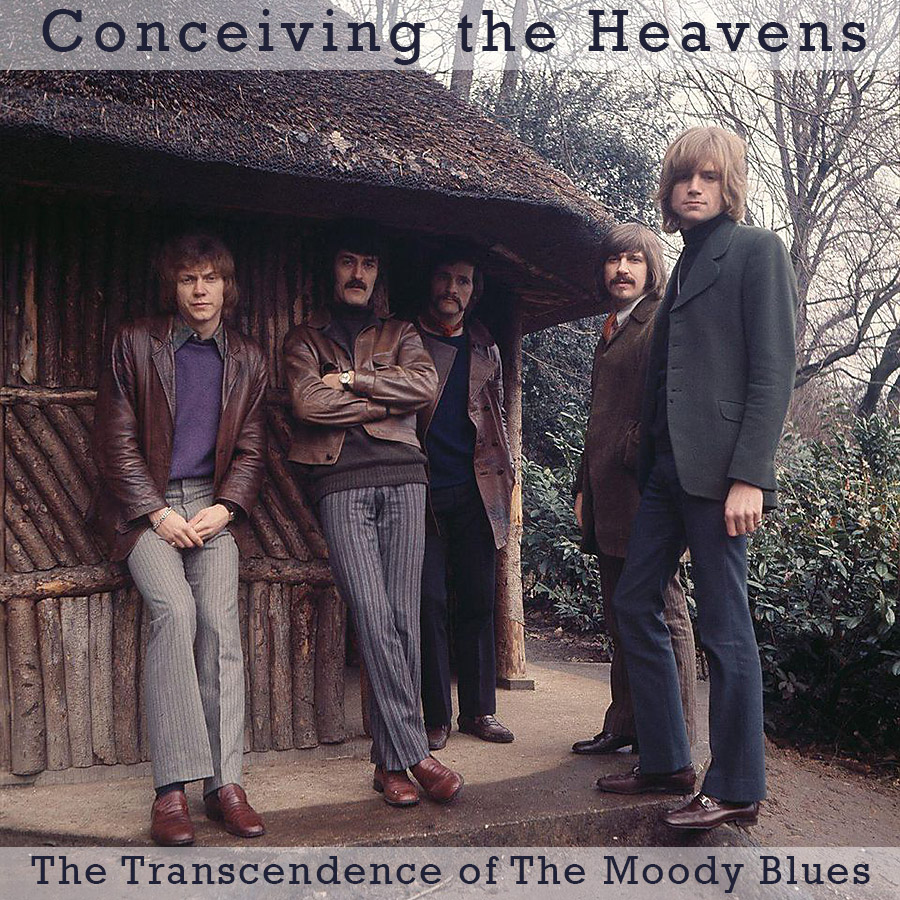
In any case, regardless of whether they really did or not, Graeme Edge, Justin Hayward, John Lodge, Mike Pinder, and Ray Thomas—the core lineup of The Moody Blues from 1967 to 1978 and the one I focus on here—seemed to know a lot about a lot of very important subjects—science, history, philosophy, sociology, religion, ethics. Fans accosted them in the street for blessings or cures or wrote letters asking for their opinions on difficult moral topics. The press hailed them as gurus.[6] Etc. Perhaps they deserved a lot of the praise they received, and perhaps they'd situated themselves in a position to address some of the societal quandaries of the 1960s, as profound as those of course were. It doesn't matter, however, because by 1972 the band—especially Lodge and Hayward, the two frontmen who probably felt the most pressure to be ostensibly wise—publicly became exasperated with the state of their public image, all of which apparently inspired Lodge to boldly compose the energetic song. All this inspired Lodge to boldly compose the energetic song "I'm Just a Singer (In a Rock and Roll Band)", which closed their last album (Seventh Sojourn) before a several-year hiatus—a pause in group activity replete with attempts at less philosophically oriented solo careers.
It's pretty clear in the lyrics Lodge wrote for "Just a Singer" that he tried to convey a strong and clear message: mainly that massive societal issues were far beyond the band's capacity to address. The song, though, happens to come across as one of those rare moments in the history of rock music in which self-deprecation coexists with such intensity and poise that it all completely, paradoxically undoes itself.[7] I mean, can we really agree with Lodge when he sings he's "just" a singer in a rock and roll band when he belts out something like "music is the traveler crossing our world / meeting so many people bridging the seas" right before the refrain at the end, twice? As usual, Lodge is very skillful and affecting in phrasing his lyrics. See, if we decide to wholeheartedly believe in the message—that the Moodies qualified as much as anyone else to speak on important subjects—then we must also reduce the message itself as nothing special. If, on the other hand, however, we reject Lodge's words outright (i.e., we disagree with them and claim the Moodies qualify much more than they let on) then at that point we are again discounting the song’s message.
In this way then, "Just a Singer" can come across as self-defeatist or worse, bitter. And it does in places. "Please tell me!" At once, though, the piece of music rocks and rolls—at a fast 150 beats per minute (Allegro!)—to such an extent as to be completely without a doubt the product of discipline and expertise. In any case, you know that when The Moody Blues of all people turn to a sour mood, it's time for some sort of a break. They would not reunite and return to the studio until recording an album (Octave, released in 1978) that would achieve considerably less praise and sales than their previous studio efforts. Anyway, societal times had changed significantly by then, when disco and punk had largely taken over, and so the currents in Western popular culture largely moved to less civilization rescuing and more into either dancing the night away oblivious to the world or spitting in the world's face from under spiked hair.[8]
Thus, by that juncture, the band's sort of hippie intellectualism no longer occupied a privileged place in society at large. Their focus would drift for a few years before hitting upon on a softer, more commercial sound in the electronic pop-rock scene that swept through the mid-1980s. To their credit they did adapt to a shifting cultural landscape where some groups originating in the 1960s had failed to find stability, because certainly not all of their peers managed that transition. They continued touring for many years after that even, playing amphitheaters to sold-out crowds of aging baby boomers and their now-adult children who remembered and still appreciated their tunes and wisdom. My parents and I turned out for their 1997 tour of America, in fact. To me they will probably always be vital and important, perhaps more so than they would have ever modestly preferred to admit.
3. A Lost Word
The space between the stars, galaxies, and other celestial objects—the background of the universe—looks to be totally dark when viewed through an optical telescope. But, when viewed with a very sensitive radio telescope, it appears to faintly and almost uniformly glow. Named the Cosmic Microwave Background Radiation (CMBR), it's what most cosmologists believe to be the remainder of the thermal energy from an early stage of the development of the universe. Extremely cold, averaging just 2.725 degrees Celsius above absolute zero, and peaking at a frequency of 160.2 GHz, it doesn't sound like much; however, discovering the CMBR in 1964 crucially supported the theory that the universe began with a "Big Bang"—e.g., small and faint irregularities in the CMBR, termed anisotropies, were found, the discovery of which provides some evidence in favor of the Big Bang model of cosmological origin.
Poetically, hence, and following the onomatopoeia, we might say the universe still rings faintly like a bell from that original bang. This kind of figure of speech feels familiar to us, although we don't usually notice it as such. We humans have long applied tangible terms to the otherwise intangible—a process essential to making meaning, after all—and I would argue religions have long been great examples of this. At a loss to explain the major events in our lives—birth, the sun, the seasons, the moon, death, and so forth—we invent what can only (now) be called supernatural [9] explanations for them. In a real way, the Big Bang theory is just another in a long line of conceptualizations designed to satisfy our need to answer the question of how all this came about and why everything exists rather than nothing at all.
Supernatural explanations for the existence of the universe such as Genesis and scientific ones such as the Big Bang are distinctly and fundamentally different from each other, though, since the latter's methodology includes peer review and testing for supporting evidence. Several thousand years into this meaning making process, languages populate themselves with words that contradict science. After only a few centuries of scientific enlightenment, people still use patterns of speech on a daily basis that expose superstition—Google's "I'm Feeling Lucky" button, "bless you" to a sneeze, the sun "sets" and somehow "rises", and so on. Our Big Bang theory, as a term and in those terms, can be seen as a huge misnomer, therefore. "Big" is relative, since the size of the universe in those early moments would be beside the point.[10] "Bang", naturally, also takes poetic license, as if it was something that could be heard.[11]
Traditionally, Hinduism holds that when creation began, a divine consciousness took the form of the original vibration which manifested as the sound "Om" (pronounced as "aum" or /ɔm/). Buddhism, having derived from Hinduism, also makes use of the word within short mantras (sounds) and in lengthier dharanis (speeches). We could thus say that Om reverberates the sound of the bang that began the universe, a la the CMBR. That sounds about right, and it makes a certain synesthetic and historical sense of what The Moody Blues' drummer Graeme Edge wrote and what their keyboardist Mike Pinder recited for "The Word", the poem preceding the song "Om" that closes their 1968 album In Search of the Lost Chord[12]: "this garden universe vibrates complete... but it's all around if we could but perceive". During the verses of "Om", Pinder and flutist Ray Thomas trade off lead vocals—singing "the Earth turns slowly round / far away, the distant sound / is with us every day / can you hear what it says?"—until the chorus, when Lodge and Hayward join in with "Om / Om / Heaven / Om." Uplifting and inspirational, the song is as East-meets-West as rock music has ever been: Mellotron strings, cello, tabla, sitar, flute, English lyrics, and a single word of Sanskrit origin. Edge is careful to be clear in "The Word", however, that the word for the titular "lost chord" itself (the sound of the vibrating universe) is just that, a word: "to name the chord is important to some / so they give it a word / and the word is 'Om'". For what it's worth, the Māndukya Upanishad (the shortest of the scriptures of the Hindu Vedanta) devotes itself to the explanation of the syllable: when properly pronounced, Om consists of three phonemes—a (Vaishvanara), u (Hiranyagarbha), and m (Ishvara)—that represent the beginning, duration, and dissolution of the universe and the associated gods Brahma, Vishnu, and Shiva, respectively.[13]
Now, while no similar words exist in more recent Romantic languages, and though the meaning of Om does not exactly have wide currency, its noise can be heard in certain circles, Moody Blues-devoted, Buddhist, Hindu, or otherwise. As one might expect, Om, when voiced, is somehow at once calming and exciting, and that aspect of it notwithstanding, the arbitrary and fluid nature of language means any word like Om boils down to represent something intangible. If not for what it has come to mean, Om would be just a meager noise, that is, purely a sound. The more in tune we can be with the expression and feeling of Om, however, with the significance it can be felt and realized to have, the more it will resonate/reverberate with who we really are. An energetic power, Om is on the one hand subjective—requiring a subject possessing body/mind—and on the other hand objective—a sound vibrating in a system of elocutionist and medium. In that paradoxical sense, the sound of Om is both personally and impersonally divine, both local and universal, and both temporary and eternal.
But did The Moody Blues really think any of this through when composing or performing or doing anything for that matter? While we may never know enough to say definitively whether their art is "supposed" to create such contradictions—these amazing bursts of meaning—nevertheless we can certainly say it does. For all their giving voice to the opposite, Hayward, Lodge, et al. were necessarily in the right place and time for, maybe inadvertently, showing us how to look beyond the dark—how to see the cosmic light.

The Sanskrit, polysemous symbol representing the sacred sound Om.
Notes:
1) I suppose you could say I was moody and had the blues. By "matter to me", I mean in the sense of materialize. I didn't know it at the time, but I probably just needed a sympathetic friend. Don't we all? Back
2) It was about the time of "Watching and Waiting" and the God who hated me that I also would occasionally play in my mind as if someone or everyone was watching a movie through my eyes and ears, as if everything I saw and heard was being recorded somehow for posterity. Such wonderful selfishness! True maturation into adult ways of thinking about our place in reality, it would seem, is partly a process of letting go of or moving beyond that sort of self-aggrandizing outlook. Back
3) I realize now how the second verse and even the refrain of the chorus of "Watching and Waiting" can be read as vaguely deistic and/or heavenly—"I'll be all around you"; "my fields and my forests… for only you to share". The Moodies sometimes waxed spiritual in their words, and, bassist John Lodge's outspoken Christianity notwithstanding, that spirituality often manifested rather generally ("Watching and Waiting", Voices in the Sky", "Visions of Paradise", Gypsy [Of a Strange and Distant Time]) or more Eastern than Western ("Om", "Sun Is Still Shining", "Legend of a Mind"). Back
4) The roots of the word compassion are steeped in religious terms themselves. From Old French circa the 14th century, "compassion" quite literally means suffering together, as in experiencing pain with others. The origins of the prefix "com-" predate the rest of it, although the meaning carries forward—"together", "public", "shared by all or many" (community, common, etc.). "Passion" comes from Medieval Latin as a special derivative (for Christ's suffering on the cross) from Late Latin "passiō" meaning suffering, submission. A Buddhist outlook on compassion (concern for the suffering of others) signifies something similar to the Christian one, then. Back
5) That is to say, apart from George Harrison, who apparently devoted himself to his spiritual practice, continuing his involvement with the Hare Krishna religion from 1969 until his death in 2001. See here. Back
6) "Just because we were asking the same questions, people thought we had the answers and we didn’t—we were as dumb as s---!," said Graeme Edge during an interview in 2014. Back
7) Other examples of this gesture against being put on a pedestal in rock music are surprisingly few and far between, but "I Don’t Know" by Beastie Boys might be one. At the other end of the spectrum—i.e., the act of reveling in stardom through lyrics—seems more common. Led Zeppelin’s "The Ocean" comes to mind! Back
8) It's revealing that the drugs of choice had shifted by then, too: from the hallucinogens of marijuana and LSD (hippies) to the upper of cocaine (disco dancers) and the downer of heroin (punks). Back
9) Whether or not there ever really existed a popular myth explaining the flat Earth as being supported on a turtle's back—that turtle supported by another turtle, and so on (into "turtles all the way down")—seems irrelevant now, because the concept speaks a great deal about the fantastical aspect of creationism: that is, the more difficult the problem, the more elaborate the solution. Back
10) Current cosmological notions have it that when the universe was just 10-37 seconds old it doubled in size at least 90 times, going from infinitesimally small to golf-ball-sized almost instantaneously. Indeed, the word "Big" appears to have more to do with conveying the importance of the event than its measurable size. Where that's concerned, some cosmologists would probably want to say that the cosmos is still "banging", since its expansion apparently continues. See here. Back
11) If the universe arises in a vacuum and no one is present to hear it, does it still make a sound? Back
12) Surely one would have a difficult time arguing that it was merely a contemporaneous event when The Moody Blues produced "The Word" and "Om" for In Search of the Lost Chord, just a few short years after scientists discovered the Cosmic Microwave Background Radiation. Considering the inquisitive nature of The Moodies, I've no doubt the latter became a major inspiration to the former. Back